The abrasive journey of foundry sand
An automotive foundry’s core-making process puts sand quality, valve wear and production continuity in the same conversation
On this page
The first two ceramic valves ran for 268 hours. Then one jammed. For KOWOV, the useful response was to recover the valve and inspect what had happened inside it.
This foundry account is valuable because it includes the unsuccessful first trial. The eventual improvement came from understanding the sand and changing the design, rather than assuming that a ceramic valve suitable for one foundry would behave identically in another.
The trial began with a familiar wear problem
An automotive foundry used valves in its core-making sand transport system. The site reported an average replacement interval of about two months for its existing butterfly valves and substantial maintenance work on both valves and piping.
KOWOV supplied two DN100 ceramic ball valves. They reached the site on 28 May 2012 and were installed the next day. After an initially satisfactory operating period, the customer reported jamming on 10 June.
The grooves changed the diagnosis
Disassembly found the stem and several lined components intact, while sand had accumulated around the seats. Fine, elongated grooves appeared on both the ball and seat sealing surfaces.
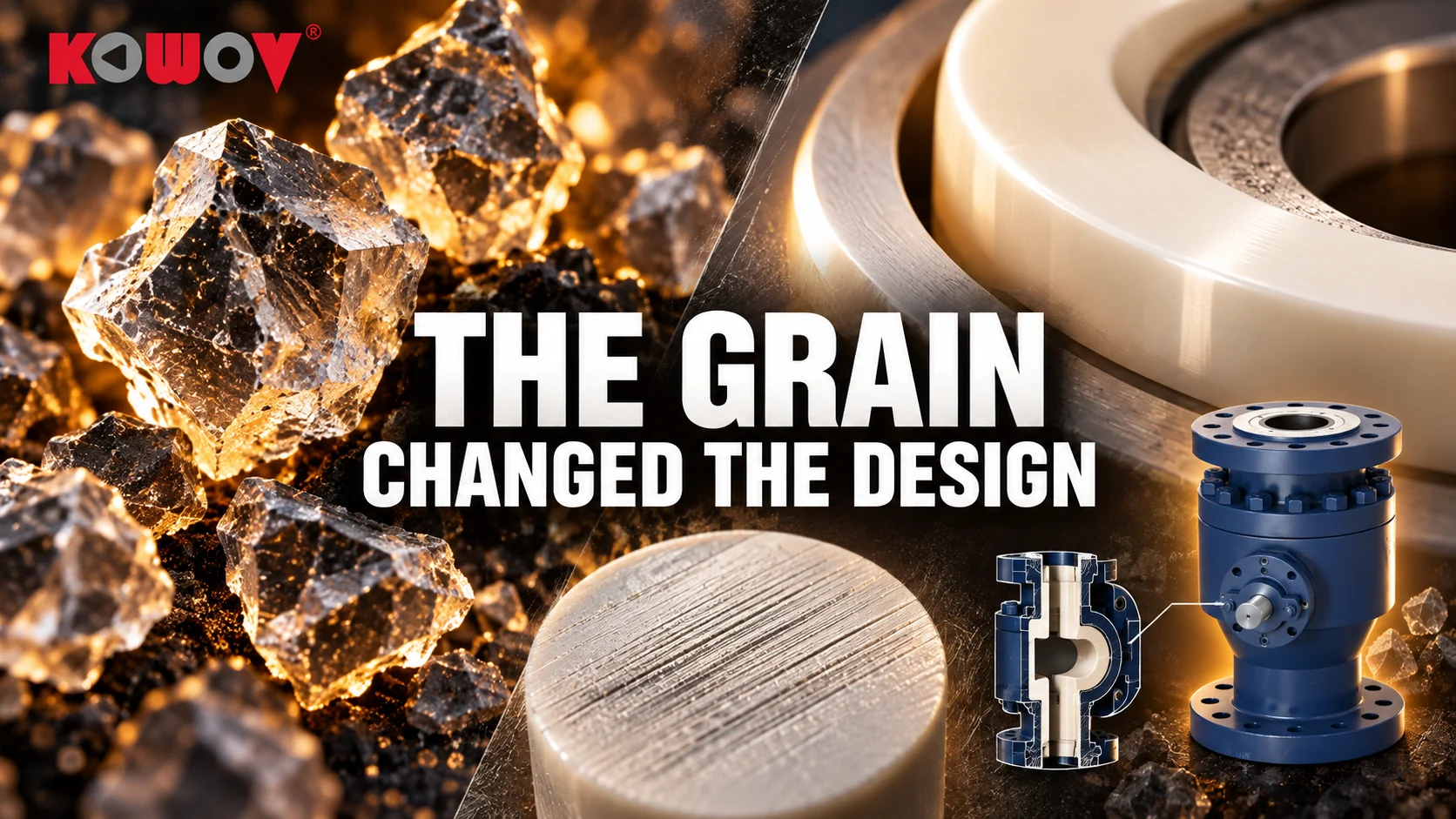
The team investigated the molding sand in more detail. The source account identifies fine, strong grains of sea sand, approximately 0.25–0.35 mm, in this plant's process. Their behavior differed from the sand encountered in earlier foundry applications.
Small particles could enter the contact region and increase friction during rotation. The report records a marked directional difference in the torque needed to turn the recovered assembly. That observation helped focus the investigation on the interaction between particles, seat and ball.
The lesson is specific: “sand” is not a sufficient material description. Particle shape, size, strength and the way it passes through the valve can change the failure mechanism.
A revised material and structure
KOWOV adjusted the ceramic composition and valve structure after the investigation. The revised valves were installed on 18 July 2012, with periodic inspection requested by the customer's technical team.
On 22 March 2013, after approximately eight months of service, the team inspected the valve again. The published account reports intact ceramic components and no visible abrasion on the inspected ball, seats and lining.
That inspection established a result for the revised construction over the elapsed interval. Later service records added the longer-term evidence; the early inspection alone could not prove a future four-year lifetime.
The next weak point was in the piping
As the valve maintenance burden fell, wear in metal elbows and tees became more prominent. The customer asked KOWOV to supply ceramic-lined replacements for those components as well.
The first ceramic elbows and tees entered use in October 2013. The account reports satisfactory service over the following year and continued operation of the ceramic valve and piping components until the plant relocated in 2017.
This is a useful systems lesson. Improving one component can reveal the next wear-limited part of the transport line. The ceramic-lined piping range should therefore be considered alongside the valve where elbows, tees or reducers show similar damage.
What to send with a foundry enquiry
For a new assessment, provide a sand sample description, particle-size distribution, grain shape, moisture, conveying pressure and cycle rate. Include photographs of the grooves, deposits and any damaged piping.
The FCCV1 ceramic ball valve is a relevant current starting point for suitable abrasive duties, but the historic custom construction should not be identified as a current model without checking its configuration. The important KOWOV capability demonstrated here is the investigation and revision of the material-and-geometry combination.
Agree an inspection plan that looks at the sealing surfaces as well as whether the valve still moves. That makes a trial informative even if it reveals a problem early.
Discuss your application
Review the sand characteristics and wear in the valve and adjoining pipework