A valve story from heavy soda production
Following the operating conditions and valve choices in an abrasive soda ash production process
On this page
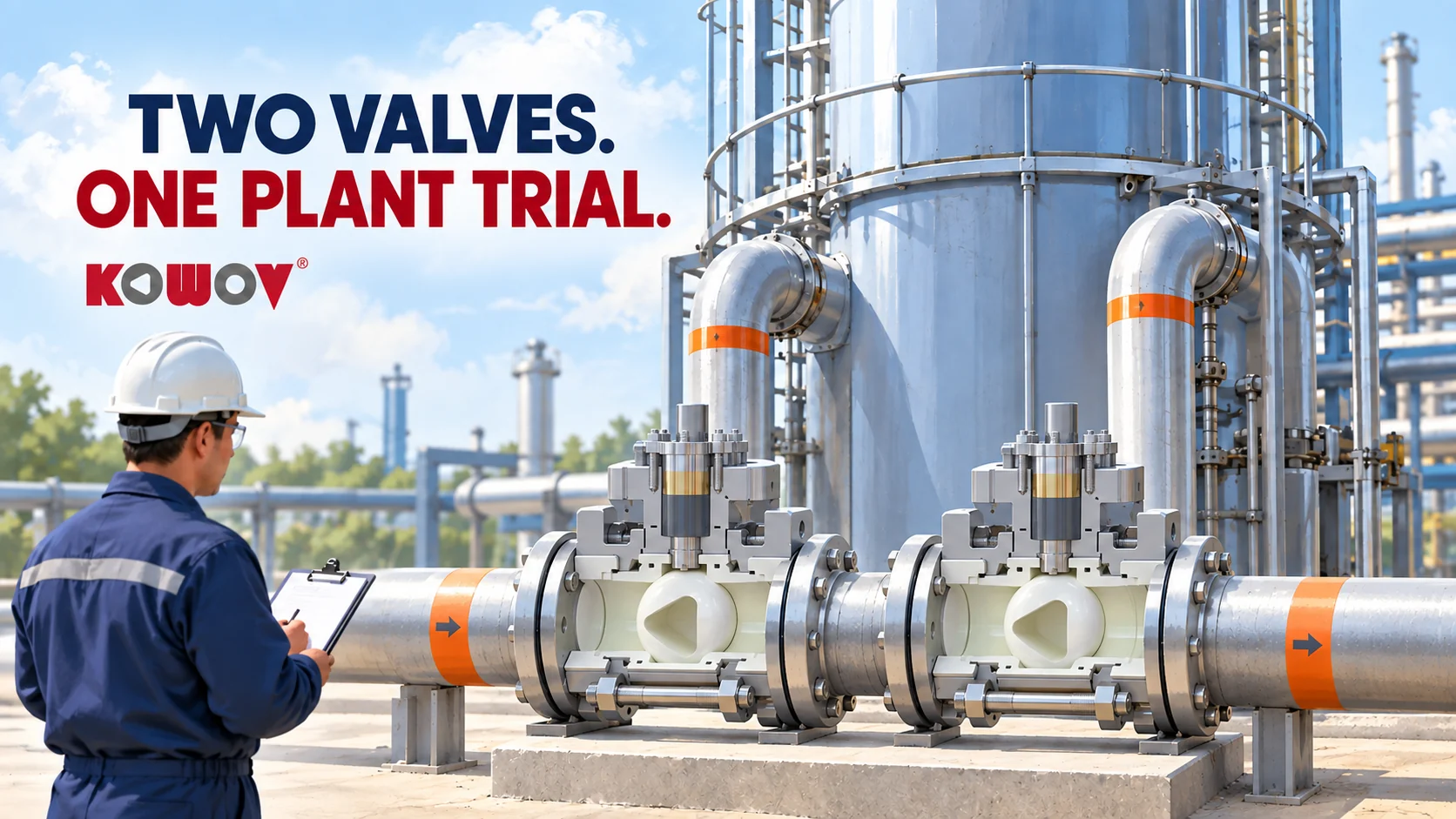
The customer agreed to try two valves. That modest decision gave KOWOV a way to test a ceramic construction in the customer's own ammonia-brine line before the plant committed to a wider replacement.
The account begins in 2020 at a soda ash factory in Guangdong. The existing valves at the carbonation-tower inlet suffered from erosion, crystallization and short replacement intervals. A sales conversation became useful when it moved into a discussion of those operating conditions.
The position the two valves had to serve
| Item | Reported condition |
|---|---|
| Position | Ammonia-brine isolation at the carbonation-tower inlet |
| Temperature | 80 °C |
| Differential pressure | 0.3–0.4 MPa |
| Recurring problems | Sealing-surface erosion and internal crystallization |
The medium contained a mixture of salts and could form solids and scale. The customer's earlier stainless-steel and lined valves reportedly lasted no more than about six months in this service.
The replacement needed to handle both the liquid chemistry and the solids. It also had to fit the actual isolation duty and the plant's maintenance practice.
From a call to an on-site review
KOWOV's sales team introduced the ceramic-valve option by telephone, followed by an online presentation. The customer described the failures, and the technical team arranged an on-site discussion.
The plant then chose a two-valve trial. This limited the initial installation while allowing the customer to inspect the same construction under normal process conditions. The KOWOV ceramic ball valves entered service in October 2020.
The scheduled inspection mattered
After six months, the plant inspected the valves during a planned shutdown. According to the published account, the ceramic components showed no visible wear or corrosion. That finding gave the customer a basis for extending their use.
The next useful point in the record is the August 2024 follow-up. The original two valves were still reported in operation, approaching four years after installation. An expected lifetime beyond six years appeared in the earlier account, but the observed result remains the dated service history.
The customer's wider adoption followed that experience. The sequence is clear: a defined duty, a limited trial, an inspection and later expansion.
Use the trial logic for the next project
The historical account does not identify the exact model code. For a current brine or slurry enquiry, review the FCCV1 ceramic ball valve and discuss whether deposits call for a single-seat construction or ceramic C valve.
Provide the complete brine composition, temperature range, solids and crystallization behavior, pressure conditions and shutoff requirement. Agree the inspection interval and what constitutes a successful trial before installation.
The ammonia-evaporation case examines a different duty in the same industry, where regulation of hot lime slurry was central to the replacement decision.
Discuss your application
Define a brine-valve trial with clear operating and inspection conditions