Ceramic Valve Solutions for Lime Slurry Control
Reliable flow control and dosing for abrasive, alkaline and scaling lime slurry in soda ash, chlor-alkali and brine-treatment systems
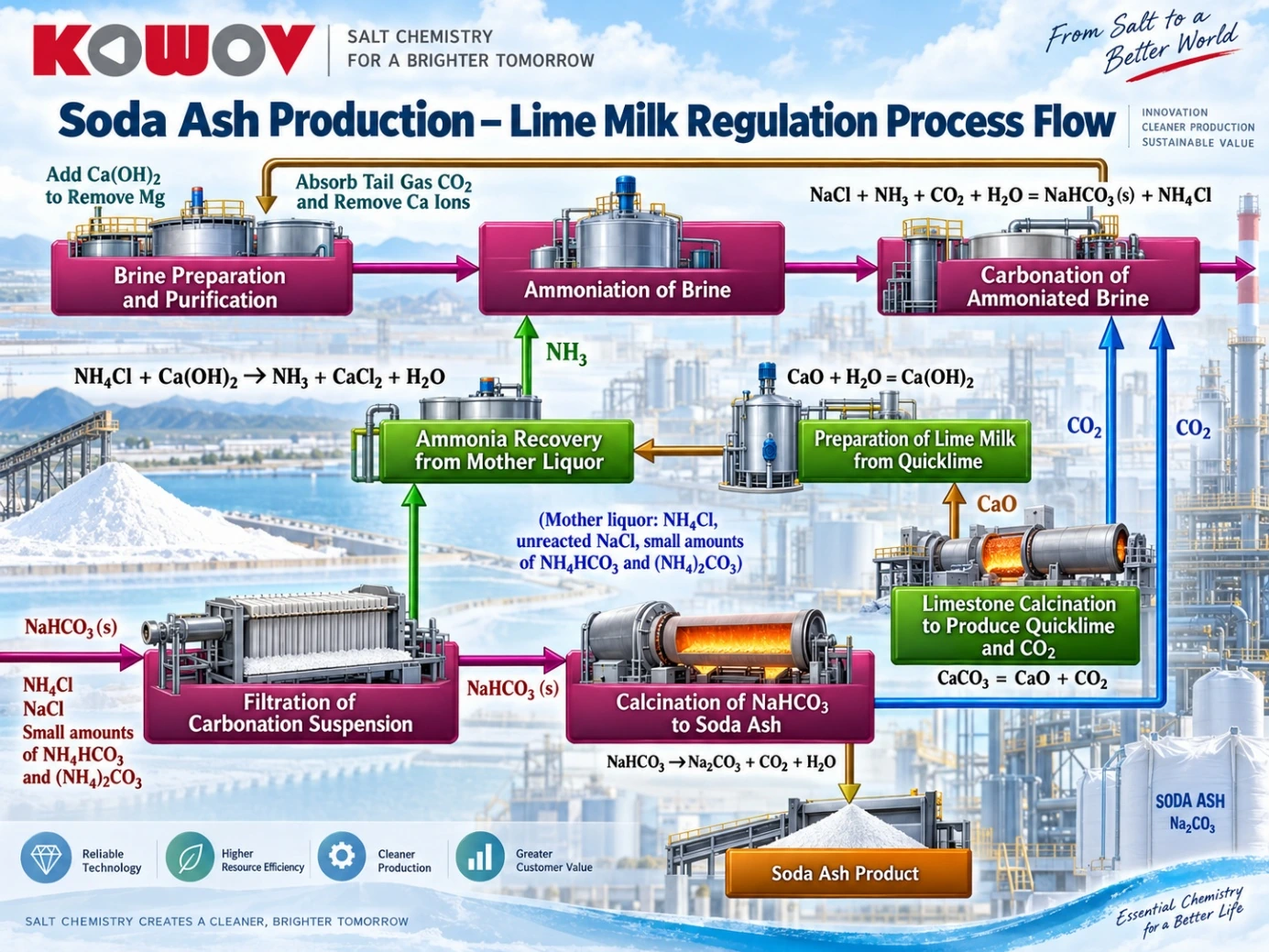
In salt-based chemical processing, particularly the chlor-alkali and soda ash industries, lime slurry, also known as milk of lime and consisting primarily of calcium hydroxide, Ca(OH)₂, is widely used as an essential purification and neutralizing agent in several critical process stages. Its principal functions include pH adjustment, removal of impurity ions such as magnesium and sulfate, and resource recovery
Operating Conditions
Within salt-chemical processing systems, lime-slurry control performs three essential functions: magnesium removal, sulfate removal, and ammonia recovery. Whether used in brine purification, ammonia distillation in soda ash production, or high-salinity wastewater treatment, accurate lime-slurry dosing and complete reaction are prerequisites for the long-term stable operation of downstream processes such as membrane electrolysis and evaporative crystallization
| Parameter | Value | Classification | Specification / Characteristics |
|---|---|---|---|
| Medium | Lime slurry / salt sludge | Liquid-solid two-phase | Corrosive and abrasive |
| Pressure range | 6-16 bar | Pressure class | Class 150 / PN16 |
| Differential pressure | ≤6 bar | Nominal diameter | DN25-DN200 |
| Temperature range | <100°C | - | No thermal shock |
| Medium Property | Details |
|---|---|
| Chemical composition | Magnesium hydroxide, calcium carbonate, barium sulfate, and other precipitates |
| Corrosive components | High concentration of chloride ions (Cl⁻) |
| Corrosiveness (pH) | pH 8-10 |
| Solids content | 15%-20% |
| Particle size | 20-80 μm |
| Particle hardness | Approximately Mohs 2.5-3 |
Operating Conditions
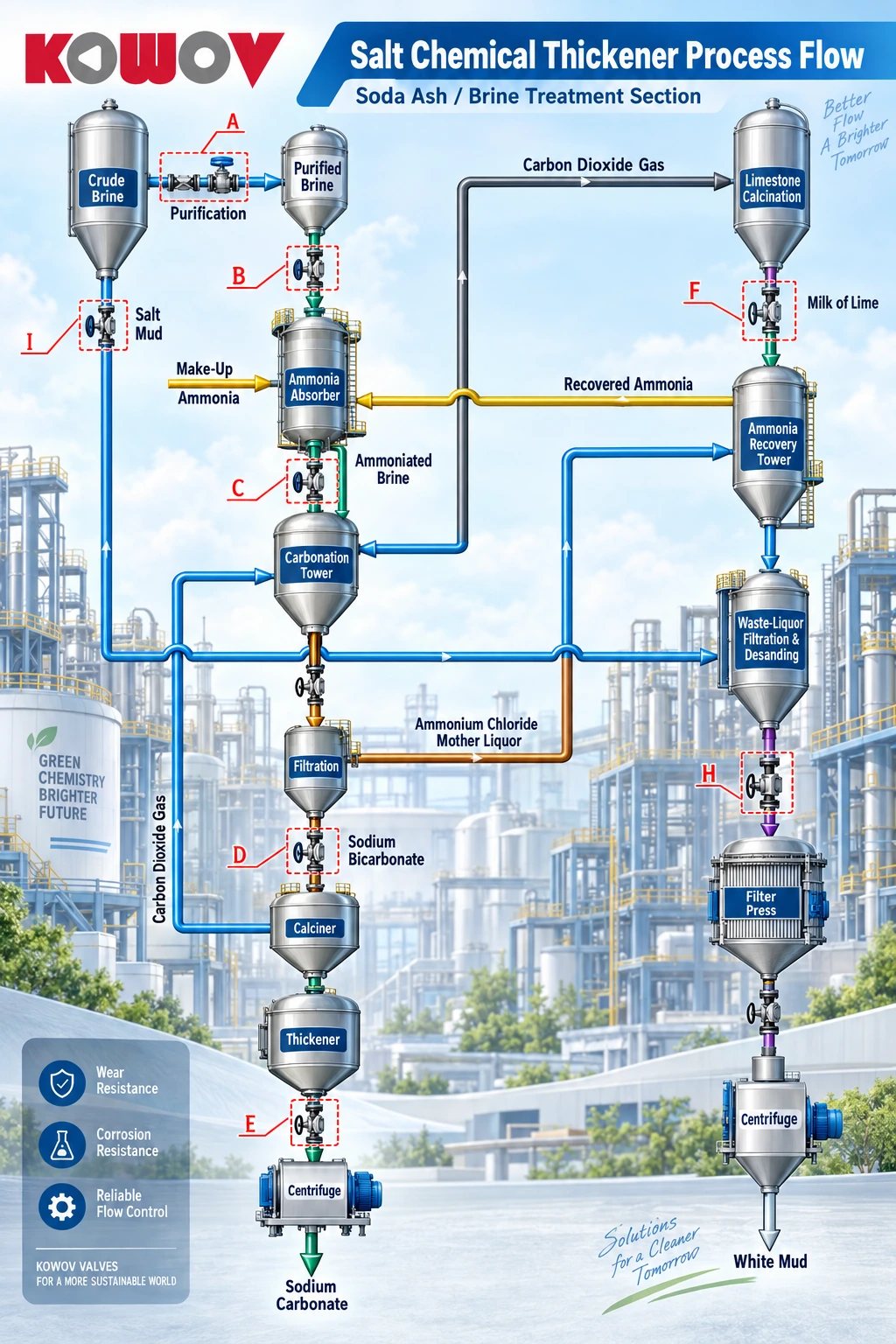
In the ammonia-soda process for soda ash production, the brine system is the critical upstream stage of the entire production line. The process medium is chemically complex, containing high concentrations of chloride ions and ammonium compounds, as well as calcium- and magnesium-bearing solid particles. Combined with elevated temperatures and high-velocity flow, these conditions expose conventional metal valves to severe corrosion, abrasion, crystallization, scaling, and blockage. Key applications include brine purification and filtration, ammoniated-brine preparation and carbonation, wastewater treatment, and lime-slurry recovery
| Parameter | Value | Classification | Specification / Characteristics |
|---|---|---|---|
| Medium | Salt sludge / lime slurry | Liquid-solid two-phase | Corrosive and abrasive |
| Pressure range | 6-16 bar | Pressure class | Class 150 / PN16 |
| Differential pressure | ≤6 bar | Nominal diameter | DN25-DN200 |
| Temperature range | <100°C | - | No thermal shock |
Medium Details
| Medium Property | Details |
|---|---|
| Chemical composition | Brine slurry, sodium bicarbonate suspension, ammoniated brine, and lime slurry |
| Corrosive components | High concentration of chloride ions (Cl⁻) |
| Corrosiveness (pH) | Not specified |
| Solids content | 15%-20% |
| Particle size | 20-80 μm |
| Particle hardness | Approximately Mohs 2.5-3 |
Special Operating Conditions
Chemical Corrosion
Lime slurry and salt sludge contain relatively high concentrations of chloride ions (Cl⁻), organic acids, heavy metals, and other corrosive substances. Under high-salinity conditions, typically 3%-8% or even higher, conventional carbon-steel and stainless-steel equipment is highly susceptible to severe chloride-induced pitting and stress-corrosion cracking
Physical Abrasion
Lime slurry and salt sludge contain large quantities of hard solid particles, such as silica and carbonates. During high-velocity flow and pumping, these particles continuously erode pipelines, valves, pump bodies, and other flow-path components. High-hardness, wear-resistant materials are therefore required
High Viscosity and a Strong Tendency to Crystallize and Block
Salt sludge is a highly viscous paste-like medium. During dehydration or drying, water evaporation causes it to enter a plastic state, sharply increasing its surface adhesion and allowing it to accumulate on production equipment
Crystallization and Scaling
Crystallization and scaling in lime slurry are not caused merely by physical adhesion. They result from the combined effects of chemical conversion through carbonation, physical expansion caused by supersaturation and precipitation, and composite fouling. The resulting scale has high hardness and generates strong expansive stresses, making it a major cause of frequent unplanned shutdowns, equipment wear, and failure of protective coatings
Equipment Hazards
Lime slurry is strongly alkaline and readily absorbs carbon dioxide (CO₂) from the air or process gas, triggering carbonation and producing calcium carbonate precipitates. These deposits have relatively high mechanical strength, approximately Mohs 3, and strong adhesion
Engineering Hazards: Calcium carbonate can crystallize within pipelines, valve clearances, and micropores in protective coatings, forming dense, hard scale. This progressively restricts the flow passage or completely seizes the valve. Expansion during crystallization may also crack and detach protective coatings, compromising equipment sealing integrity
Keywords: Chlor-Alkali Industry | Soda Ash Industry | Soda Ash Plant | Caustic Soda Plant | Sodium Bicarbonate Calcination | Lime-Slurry Distributor | Distillation Column
Process Pain Points and Key Opportunities
Existing Valve Materials and Types
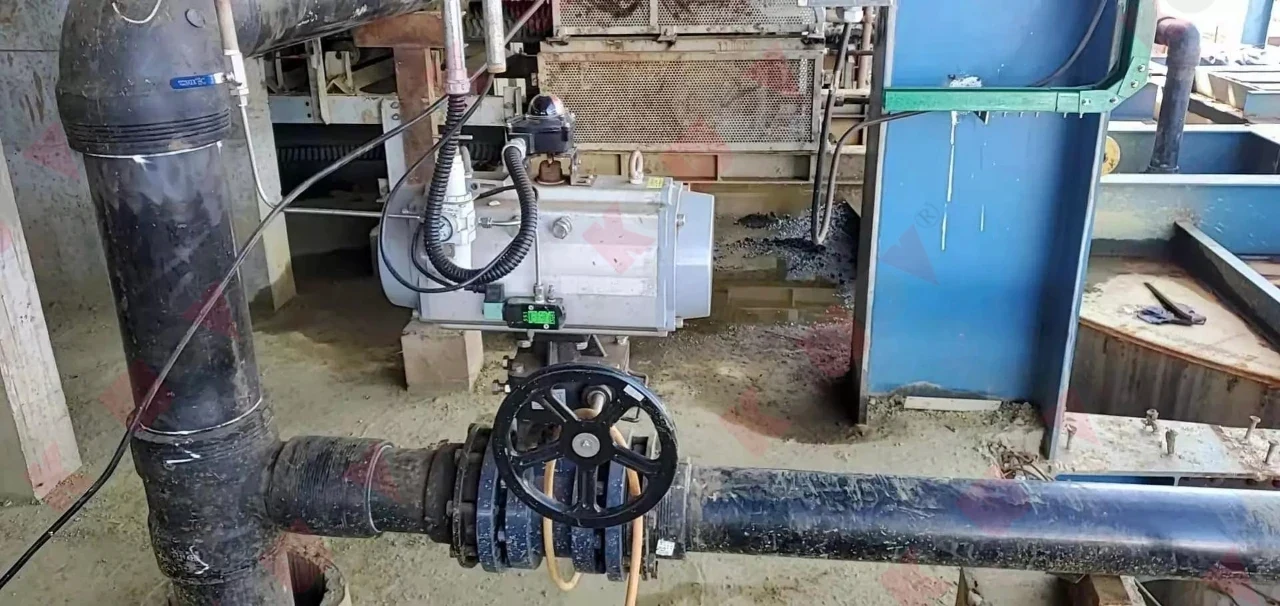
The valves commonly used on site include PTFE-lined valves, metal hard-seated ball valves, and ceramic hemispherical valves
Problems with Existing Valves
The medium is highly corrosive, strongly abrasive, and operates across a temperature range of −19°C to 180°C. Some applications also require Class VI shutoff performance. Conventional rubber-lined butterfly valves provide corrosion protection but cannot withstand continuous erosion
When lime slurry comes into contact with carbon dioxide (CO₂) in the air, a carbonation reaction occurs, producing calcium carbonate deposits. These calcite deposits have relatively high mechanical strength, approximately Mohs 3, and extremely strong adhesion, rapidly causing valve seizure and sealing failure
Replacement Cycle and Service Life of Existing Valves
Conventional valves typically last no more than two to three operating cycles. Under particularly severe conditions, service life may be reduced to only 3-4 months
Losses Caused by Unplanned Shutdown Maintenance
The lime-slurry control valve plays a critical role in accurately regulating system pH and reactant ratios. Valve failure, including sticking, internal leakage, or slow response, can directly cause loss of process control
Because lime slurry is highly corrosive, abrasive, and prone to crystallization and blockage, control-valve failure often causes interconnected equipment damage. Improper valve selection may prevent the system from maintaining process balance, forcing the entire production line to reduce load or undergo an emergency shutdown
In chemical production, failure of a lime-slurry control valve may also create serious safety and environmental risks
Why Choose Ceramic Valves?
Superior Wear Resistance
Structural ceramics achieve a hardness above HRA 87, offering approximately 266 times the wear resistance of manganese steel and 172 times that of high-chromium cast iron. Their exceptional hardness withstands continuous erosion and abrasion from solid particles, preventing media leakage and significantly reducing valve replacement frequency
Excellent Corrosion Resistance
Structural ceramics are inorganic, non-metallic materials with outstanding chemical inertness. They resist corrosion from acids, alkalis, chlorides, and other salts, making them suitable for most corrosive media encountered in chlor-alkali and soda ash plants
Smooth Surface and Low Adhesion
Structural ceramics possess inherent lubricity and self-cleaning surface properties, effectively reducing the adhesion and accumulation of lime slurry and crystallized deposits. Their hardness of up to HRA 90 withstands continuous particle erosion and helps maintain precise flow control
Improved Process Quality
The high mechanical strength and smooth surface of structural ceramics reduce the adhesion, abrasion, crystallization, and scaling of calcium and magnesium salts. Precision-machined sealing surfaces ensure close contact between the valve ball and seats, preventing media leakage. Even after prolonged operation, the valve maintains reliable shutoff performance and stable process control
Conclusion: Ceramic ball valves and ceramic C-port control valves provide reliable protection for lime-slurry regulation in chlor-alkali and soda ash plants, ensuring long-term stable operation while significantly reducing shutdowns and maintenance requirements
Commonly Used Products
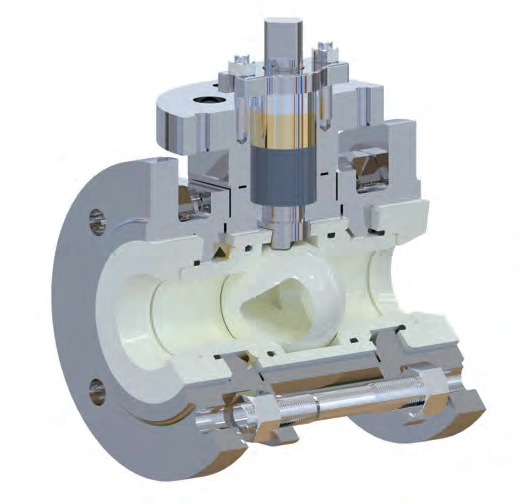
FCCV1
Standard Ceramic Ball Valve
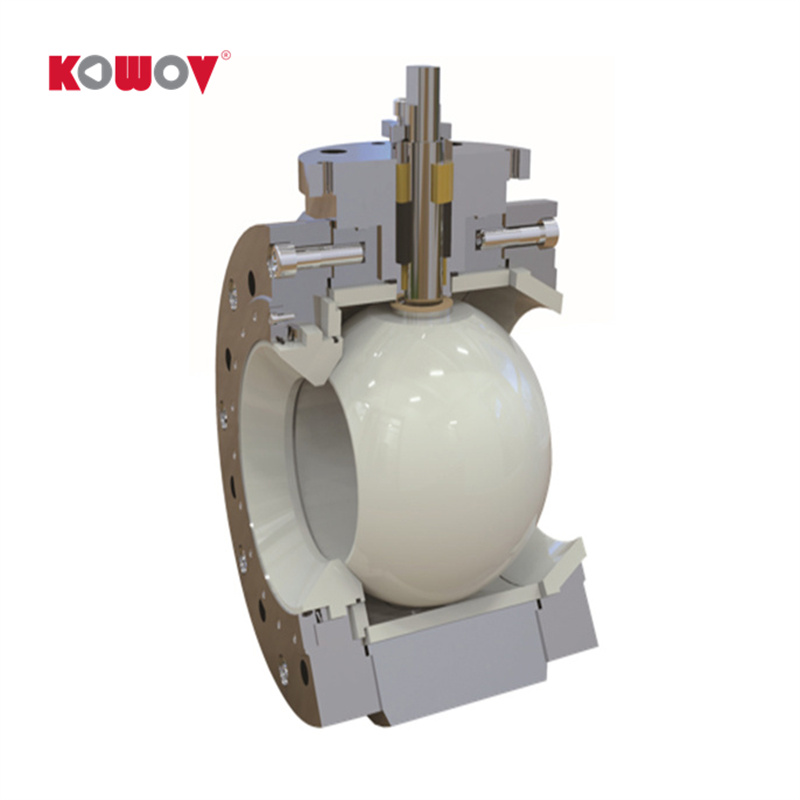
A proven and versatile ceramic ball valve with a classic design, suitable for both on/off and flow-control service. It can be used in most applications with operating temperatures up to 180°C and pressures up to 5.0 MPa, and is particularly effective for corrosive media containing abrasive solids
- Size range: DN15-250 (½″-10″)
- Shut-off class: Class IV or higher
FCRV
Ceramic C-Ball Valve
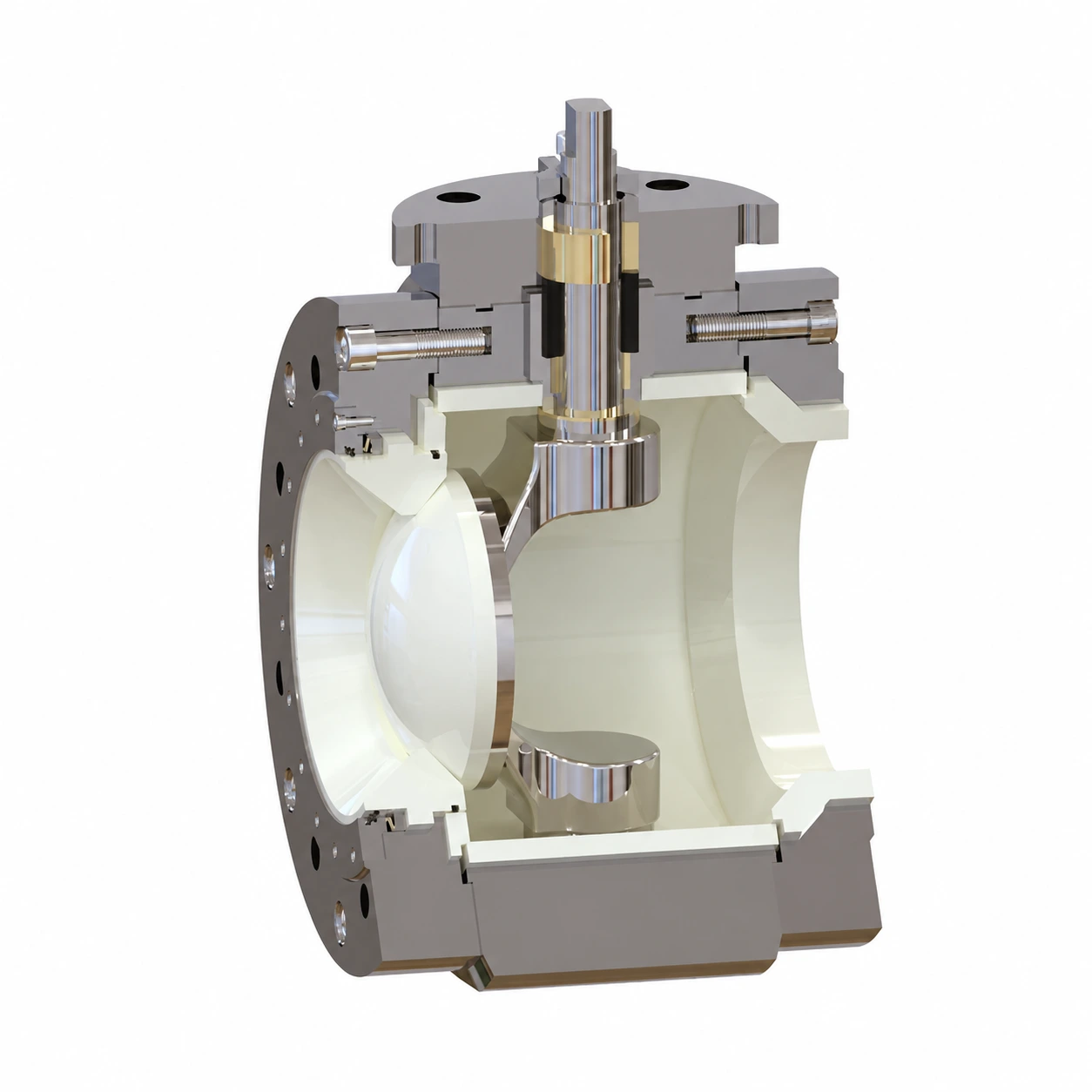
The valve features a special C-shaped structure. Its ball consists of a C-shaped metal support mechanically connected and securely fitted to a one-piece ceramic ball segment. The ceramic segment protects the metal support from direct erosion by the process medium
The concentric design keeps the ceramic ball segment in continuous contact with the seat during operation, allowing it to scrape deposits from the sealing surfaces and maintain reliable shut-off. It is particularly suitable for media prone to crystallization, scaling, agglomeration, high solids loading and valve jamming. Its cavity-free construction minimizes material accumulation inside the valve
- Size range: DN50-400
FCCV6
Single-Seat Ceramic Ball Valve
This cavity-free ceramic ball valve is designed for reliable control of highly viscous, crystallizing, scaling and agglomerating slurries and mineral slurries. Its unrestricted internal flow path supports smooth, stable, long-term plant operation
The scraping-action valve seat cleans deposited material from the ceramic ball during every opening and closing cycle,
View FCCV6Contact Us
Talk to our team about your lime slurry control application
Discuss your application